


Recycling balers can, for the right business, be a means of adding significant rebates on the bottom line. For businesses with large volumes of cardboard & pallet wrap as well as other types of soft plastics, a baler can add significant amounts to the bottom line.
Balers don’t work for everyone, however, & we’ll look into the main factors that affect whether a baler might or might not work for you. These are:
- Baler Costs
- Baler condition
- Available Storage Space
- Staff Engagement
- Volume of Recyclable Material

Baler Costs
Cost is a significant part of the recycling baler equation & there are three main elements to cost to consider when deciding whether a baler will work for you. These are:
- Purchase costs
- Transportation costs
- Landfill costs
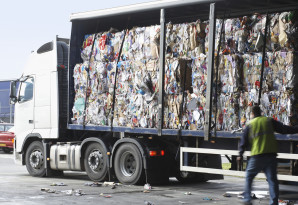
Purchase costs can make or break a deal by themselves. Baling machines cost money &, in order to get the best return, big is beautiful. Mill-size balers have a greater compacting force & enable recyclers to get more material onto any given transportation, lowering transportation costs relative to the volume of recycled material & increasing the rebate.
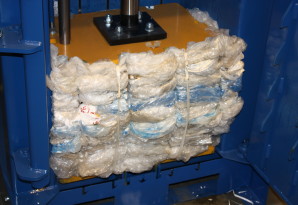
Our recommendation is that businesses consider balers that bale at 200kg upwards. The difficulty with this is that, new, these machines will cost at least £5-6,000. The advantages of this are that these balers will compact a volume of material quickly & act as stillages to keep working environments tidy & prevent employees double-handling materials.
Transportation costs are a significant factor for the recycling industry. It costs £300 on average to get materials transported from a business to a recycling area (using a haulage company). If, for the sake of mathematics, we are to say that recyclers offer end users £50 per tonne for cardboard, they would have to collect at least 6 tonnes per load just to pay for the transportation costs.
Transportation costs affect everything: they will affect how much a recycler is prepared to offer you for your material & how much money you will add to your bottom-line. Again, there is an economic advantage to purchasing a mill-size baler in that recyclers will be able to get an increased yield. With a mill size baler creating 500kg bales that fit on a pallet, it is possible to take 22 tonnes of material if pallets are stacked 2 high. This increased yield will be reflected in the amount your recycler is prepared to offer you.
Landfill costs are not to be forgotten. Although the cost of a baler may seem significant, it is important to recognise how much your business is being charged for landfill. If you are being charged per skip or per lift, the landfilling of cardboard & polythene can become a huge cost. If this is the case, a lot of this costs can be reduced by using a baler.
For many of our clients, we see reductions in landfill costs of 50-60% which amounts to thousands of pounds per year. This in itself is often enough to pay for a baler. Furthermore, when our clients realise that they are being charged for landfilling & then their current provider is taking out cardboard & polythene from their waste & generating value from it, this adds a further incentive.

Baler Condition
For some businesses, a new baler is a bit too much of an investment. Some turn to the second-hand market but this can be a false economy as, in order to generate the value that recycling can deliver, it is important that these machines work & are serviceable.
One option here is to use a reconditioned baler. Reconditioned balers are balers that have been used but have then been bought back & rebuilt by the manufacturer. The advantages of a reconditioned baler are:
- A saving of 30-40% over a new baler
- A 6-month warranty to ensure that the baler works
It is a judgement that businesses can make for themselves whether a reconditioned baler can work for them but, for most common baler sizes, reconditioned balers to become available.
Available Storage Space
Balers are a mixed blessing where storage space is concerned. They take up some space (but not a lot), they save vast amounts of space by compacting material but they also create baled material that needs to be stored before being recycled.
For most businesses, a vertical baler is more than sufficient. In terms of space these may have a footprint of 2m by 2m.
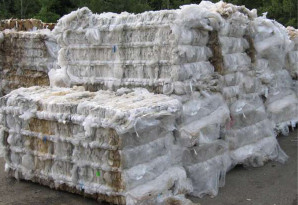
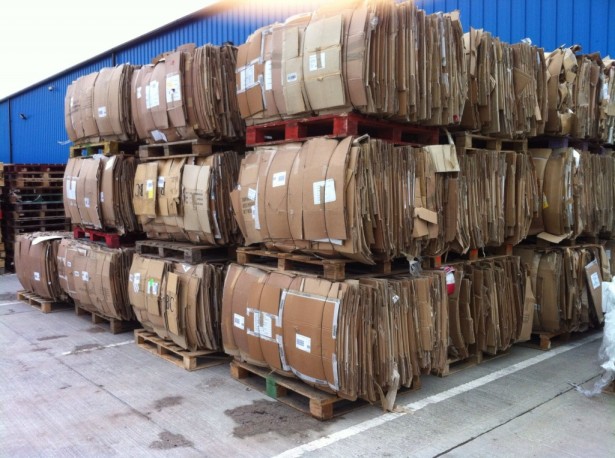
In order to get the best yields from recycling, a business needs to have the ability to store bales of cardboard. Mill size balers will eject bales onto a pallet & these can be stored outside. In an ideal world & where there is volume, the recycling company will put in a trailer so that pallets can be loaded onto the trailer directly, saving the material being handled twice. This is not absolutely necessary but it can save some labour costs.
Businesses looking to get significant rebates from recycled material do need space but, depending upon how far away they are from their recycler & depending whether their recycler will do a more regular ‘milk round’ they may be able to get away with less.
Staff Engagement
In order to make any recycling venture work, the staff play a key role. If the staff understand the importance of recycling & are aware of the value of the recycling to the business, they will be more likely to view recycling as a necessary part of their business activities rather than a chore.
For many businesses, recycling revenues pay for staff – their jobs really do depend upon it. Other businesses consider inserting a line about recycling into the job description of relevant workers to ensure that recycling is done.
When dealing with balers, recycling work is relatively simple & there is less likelihood of the contamination of loads by careless or reckless employees. That said, in order to get the best value from recycling balers, it is important that cardboard bales contain only cardboard (& not banana peels) & that clear plastic bales contain only clear plastic (& not other kinds of material which don’t command the premium that clear plastic does).


Volume of Recyclable Material
In order to make the cost of a baler justify itself, businesses need to get a return on their investment as quickly as possible. This return will be quicker if there is a volume of material & slower if the volume is lower.
There are a number of ways of estimating this volume:
- Look at your recycling tonnage reports
- Look at your landfill tonnage reports & landfill costs & estimate the volume of baleable material that is going to landfill
- Call us in for a free waste assessment
If you know how quickly you need a return from your baler, let us know & we’ll be happy to help & see if this return is achievable for your organsiation.
Will it Work for You?
So there you have it. The major factors that affect whether a recycling baler will work for you are:
- Cost – can you afford to buy the baler at & what are the other costs associated that can be saved (landfill) & that might affect your rebate (transportation of recycled materials)
- Condition – a reconditioned baler can help some businesses get their recycling off the ground & can offer a lower-cost alternative to buying new machinery
- Storage – in an ideal world, a recycling enterprise needs space to store recyclable material in order that the recycler can maximise their tonnage against diesel & transportation costs
- Staff Engagement – the value of recycled goods can only be received where staff are engaged & where recycling materials are presented in a way that is attractive & useful to the end user
- Volume – businesses that are interested in generating significant rebates from recyclable materials using a baler need to be generating volumes of material so that the capital cost will pay for itself